.jpg)


Christchurch book's authors
are fumbling in the shadows
cater to that need. — Germar Rudolf, writing in Josef Mengele — the Creation of a Myth
Have Chris Wilson and Michal Dziwulski even seen, let alone analyzed, the "livestream" of the shooting that supposedly occurred at Al Noor Mosque on March 15, 2019?
In their acknowledgments, the authors remind us that "It is illegal to possess or disseminate the terrorist's manifesto and the recording he made of his attack". They then go on to say, "We thank the Classifications Office / Te Mana Whakaatu for providing us with an exemption to use these materials".
There is evidence, however, that they have either (a) not viewed the "livestream" of the alleged attack on Al Noor by Australian Brenton Tarrant, or (b) viewed it in a cursory fashion, after assuming it is exactly what it purports to be: an accurate record of the (alleged) killing of 44 people and wounding of 35 others in and around the mosque between 1.40pm and 1.59pm on March 15.
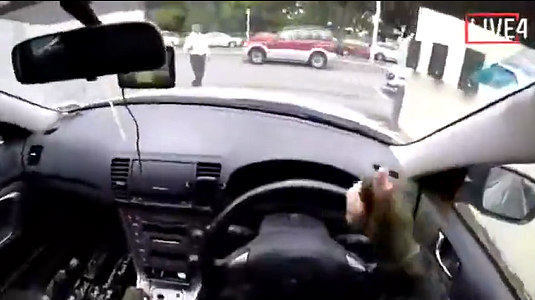 First, in describing the gunman's arrival at the mosque, they get the sequence of events back to front, writing: "He stopped to let a person cross in front of him at the end of an alleyway to the side of the mosque, giving them a thumbs-up sign." In reality, he drives to the end of the alleyway (or to a part of the alleyway that is wider), makes a nine-point turn, and then drives back towards the entrance. As he stops, about two meters from the entrance, a man on the public footpath, dressed in a white shirt and dark trousers, gives him a thumbs-up signal, which the gunman reciprocates. However one interprets these gestures, they constitute two-way communication. At this stage, white-shirt man might appear to be no more than a member of the public. And indeed, after a brief pause, he crosses the entrance to the alleyway and continues to walk along the footpath. It is not until later, when he is seen disappearing behind the mosque, that he becomes a subject of speculation.
Second, a major actor in the drama — Mohamed Jama, former president of Al Noor Mosque — who was prominent in all early versions of the official narrative, is absent from the story told by Wilson and Dziwulski. In the "livestream", Jama is the man in the white suit who is seen standing with an unidentified woman outside the main gate of the mosque compound as the gunman approaches for the first time. Although Jama does not react in any way, all previous versions of the official narrative have had him accosting the gunman and, in one version, miraculously escaping from the confrontation with no more than a bullet hole in his clothing.
Third, the authors make no mention of one of the major puzzles of the entire event: the presence of a person who remains seated in a car, Rego FQH875, parked to the left of the mosque's main entrance throughout the first part of the "shooting". The gunman raises his weapon and points it at this person as he exits the mosque after his first rampage, but doesn't fire. Then, when the gunman returns to the mosque, he enters the compound via the carpark entrance while the car leaves the compound via the main entrance.
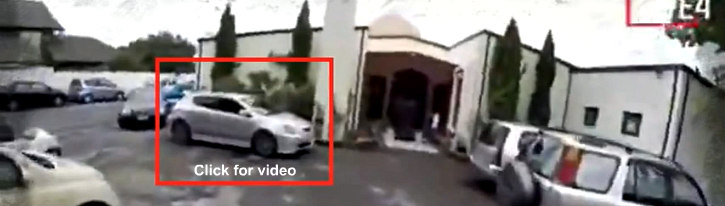
Fourth, we have the statements on Pages 183-184: "He [alleged shooter Brenton Tarrant] reportedly said to his livestream: 'Did not go as planned.' He laughed and swore, and then drove over Ansi Alibava's body." But if the authors had viewed the "livestream", they would have heard Tarrant say this. They would not have felt constrained to insert the adverb "reportedly". Furthermore, they would have heard him say it after he drove over what purported to be Ansi's body, not before. The respective times are: 12:27 (drives over "body") and 12:37 (says "Did not go as planned"). This is a small point, but it proves that this book's researchers have not done their homework.
Throughout the chapter on the actual "attack" — titled "Atrocity" — we find references to worshipers diving to the ground and running in different directions (P178), people escaping through a broken window (P179), and screams of the wounded being amplified by the public address system (P180). Then, later, we are told that people up and down the street had to run and hide as the gunman fired in both directions.
In reality, little of this happened. Inside the mosque, I see no one dive to the "ground". I see a scene, frustratingly fleeting, in which a huddle of people, who appear to be crouching, slump to the floor when the gunman fires towards the corner immediately to his right at 6:59, seconds after he has entered the main prayer room.
 I see no one escaping through a broken window. In fact, the only (non-vehicular) broken window we see during the entire drama is in the former KFC building adjacent to the Linwood Islamic Center. This has been shown repeatedly on television, and audiences have been led to believe it is/was a window in the center. The police have also been a party to this deception, as an officer has posed in front of the window while apparently comforting a member of the Linwood congregation. Thus, we have indisputable evidence of police complicity in this staged event. (For more information, see the website https://chchtruth.com.)
Furthermore, I see only three men running: the man who is targeted through an open door on the right of the hallway as the gunman approaches the main prayer room after making his initial entry (6:51), the man who runs across the entrance to the main prayer room (6:53), and the man who is targeted as he tries to escape via the main entrance (8:11-8:15).
Meanwhile, all I hear is a sepulchral maundering that rises and falls from the moment the "shooting" starts but doesn't seem to come from anywhere in particular. I hear no distinct exclamations from members of the congregation or audible "pleas of the wounded to be spared", as reported by Justice Cameron Mander in his sentencing of Tarrant on August 24, 2020. (I also hear no "Hello, brother", "As-salamu alaykum" or other greeting as the gunman initially approaches the main entrance of the mosque, although I hear sounds that might be construed as some form of greeting.)
Outside the mosque, the gunman does shoot up and down Deans Avenue, but it's hard to tell what, if anything, he is shooting at, as no one is visible.
Likewise, there is no evidence that Husna Ahmed was shot while attempting to reenter the mosque to look for her husband and left "on the pathway outside". Contrary to the reports that there were dead and wounded people all around the mosque after the "shooting", only two "bodies" were found — that of Ansi Alibava at the entrance to the alleyway and that of an unidentified woman, dressed almost entirely in pink, about 20 meters farther down Deans Avenue. (Since the official narrative has only two female fatalities at Al Noor, one has to assume that Pink Lady is supposed to be Husna.)
There are, in the public domain, several photos of "survivors" of the "shooting", including imam Gamal Fouda, who reassembled in the alleyway only a few meters from Ansi's unsequestered "body" — in flagrant violation of the procedural rules for the management of a crime scene. Not one of these "survivors" is wounded, and not one of them shows any sign of tension or distress. On the contrary, they look bored as they gossip and fiddle with their smartphones. In two scenes, their police handlers appear to be giving them instructions on what to do and/or where to go next.
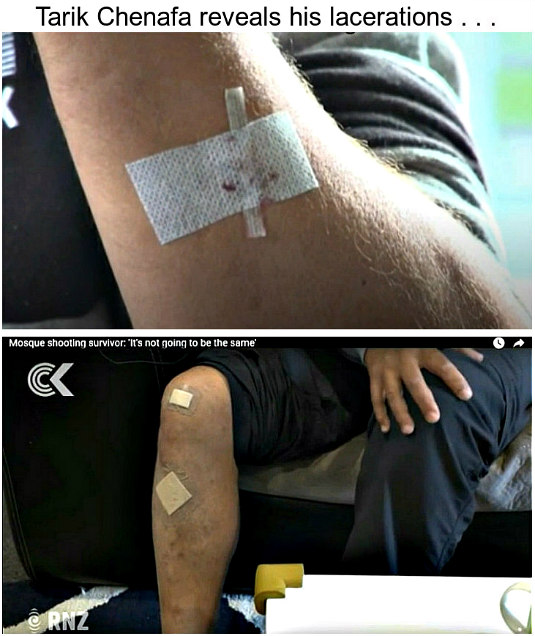
 There are also several photos of the "wounded" being rushed to hospital by ambulance, not one of which has been included in Wilson and Dziwulski's "definitive" account of the event. But that omission is hardly surprising, as the skeptical investigator searches in vain for a single spot of blood on any of them. Equally fruitless is a search for signs of serious injury in later photos of the "victims" in hospital. And since the discharge of these patients, the few "injuries" that have been displayed, amid appropriate clucks of commiseration from credulous (or complicit) journalists, have consisted of either minor scratches or old scars. The compression bandage on Temel's left arm (see above) is not for a gunshot wound; it's for an injury that, when the bandage is removed, looks like some kind of burn he suffered before March 15.
Equally unbelievable is the claim that one of the senior constables who arrested "Tarrant", after shunting his car into the curb on Brougham Street, "struck him in the head with the butt of a rife, rendering him unconscious". The video of the arrest, made by someone in a car traveling in the opposite direction, clearly shows that the suspect, who incidentally doesn't look like any of the other Tarrants we have seen, is still wearing his helmet. So where, exactly, did the officers hit him? And if he was rendered unconscious, how was he so quickly able to tell them that "other individuals were involved in the attack"? My guess is that they made up the butt-to-the-head story because the video clip shows the suspect falling to the ground like a rag doll when the officers flip him on to his face.
 Thus, anyone who looks at the evidence, instead of listening to the talk, is led to the conclusion that March 15 was a grotesque charade and that the "livestream" was suppressed because it doesn't stand up to scrutiny.
The authors of He Told Us say they wrote their book to remedy some of the deficiencies of the Royal Commission of Inquiry report on the "atrocity". And in this endeavor they have gone to great lengths to ferret out social media posts, most of them on 4chan.org/pol, that record Tarrant's "radicali-
zation". Their thinking is that, if we had known more about the "terrorist" (as they always refer to him), we might have been able to stop him. But I, for one, have doubts about this. When I went online in 2000, one of the first things I discovered was that virulent anti-Muslim rhetoric was to be found everywhere — even in mainstream forums. Common comments were along the lines of "We should nuke Mecca and Medina to show who's boss" and "We should turn their (Muslims') countries into parking lots".
Besides, according to what criteria would one determine that Islamophobe A is more likely to commit a terrorist attack than Islamophobe B? How does one distinguish between braggadocio and genuine intent? How successful has the Prevent program been in Britain? In one extreme case there, nursery school staff threatened to refer a 4-year-old boy to the program after he drew a picture of his father cutting a cucumber with a knife, which staff believed showed his father making a "cooker bomb". (Nursery 'raised fears of radicalisation over boy's cucumber drawing', The Guardian, March 11, 2016.)
Although the suspicion the gunman had accomplices was speedily dismissed, the "livestream" suggests there were others involved. One possible accomplice is the figure in red who walks past his car at 4:10, while he is parked beside the road. The gunman makes a movement with his right hand, which some observers have interpreted as a gesture of acknowledgment. He then drives off, having inexplicably remained parked for almost exactly a minute. Another possible accomplice is the man in a red boilersuit, dubbed "pit-stop man", who is seen walking past the entrance to the alleyway as the gunman arrives at the mosque. Yet another possible accomplice is the "white-shirt man" mentioned above. (In some previous terrorist attacks, including the Melbourne car attack of 2017, figures in distinctive clothing were apparently used as signals or markers.)
The suggestion that others were involved is also supported by the fact that, in many previous cases, "radicalization" has proceeded in tandem with recruitment by one or more of the security/intelligence agencies, according to a modus operandi outlined by Trevor Aaronson in The Terror Factory: Inside the FBI's Manufactured War on Terrorism. Basically, the recruiter monitors online forums, telephone communications and physical meetings to identify potential "lone wolf" terrorists. A suitable candidate is then groomed for as long as it takes to prepare him for an operation. In the meantime, the candidate remains unaware he has been recruited and thinks his "cobber" is just another comrade-in-arms.
Since the Cold War era's Operation Gladio, the phenomenon of the terrorist attack has been seen as a catalyst for any desired social/political change that would not be accepted by the public under normal circumstances, especially if it is likely to entail a drastic curtailment of such fundamental civil liberties as freedom of speech, assembly and movement. For this reason, people have to be panicked into acceptance of the planned government
But the modus operandi has changed since the days of Operation Gladio. Today, the perpetrators of false-flag terror events prefer to use fake victims, including dummies, which are easier to manage than real victims. Anyway, real victims are unnecessary, as the public can be persuaded, through "sustained propaganda",
Face in the mirror

As the alleged gunman turns into the alleyway beside the mosque, we get several glimpses of his face in the rearview mirror. Is this the face we saw earlier, when he inexplicably parked for a minute while en route to the mosque? For further information, go to Gareth Jacob's Forensic Video Analysis Report, Pages 5-10.
Subsidiary pages
 Remember how a pandemic preparedness exercise immedi-
ately preceded the Covid psyop?